

More In Clinical & Technical Insights
Optimizing Metabolic Protocols: The Synergistic Role of Levocarnitine, L-Arginine, and Active B12
Medical weight management continues to evolve as p...
Latest Articles
L-Arginine HCl Injection: Biochemical Mechanisms, Pharmacokinetics, and Clinical Prescribing Considerations
L-arginine is a conditionally essential amino acid...
Optimizing Metabolic Protocols: The Synergistic Role of Levocarnitine, L-Arginine, and Active B12
Medical weight management continues to evolve as p...
Overcoming Formulation Challenges in Sterile Peptide Injectables and Complex Therapeutics
Peptide therapeutics and complex coenzymes represe...
L-Arginine HCl Injection: Biochemical Mechanisms, Pharmacokinetics, and Clinical Prescribing Considerations
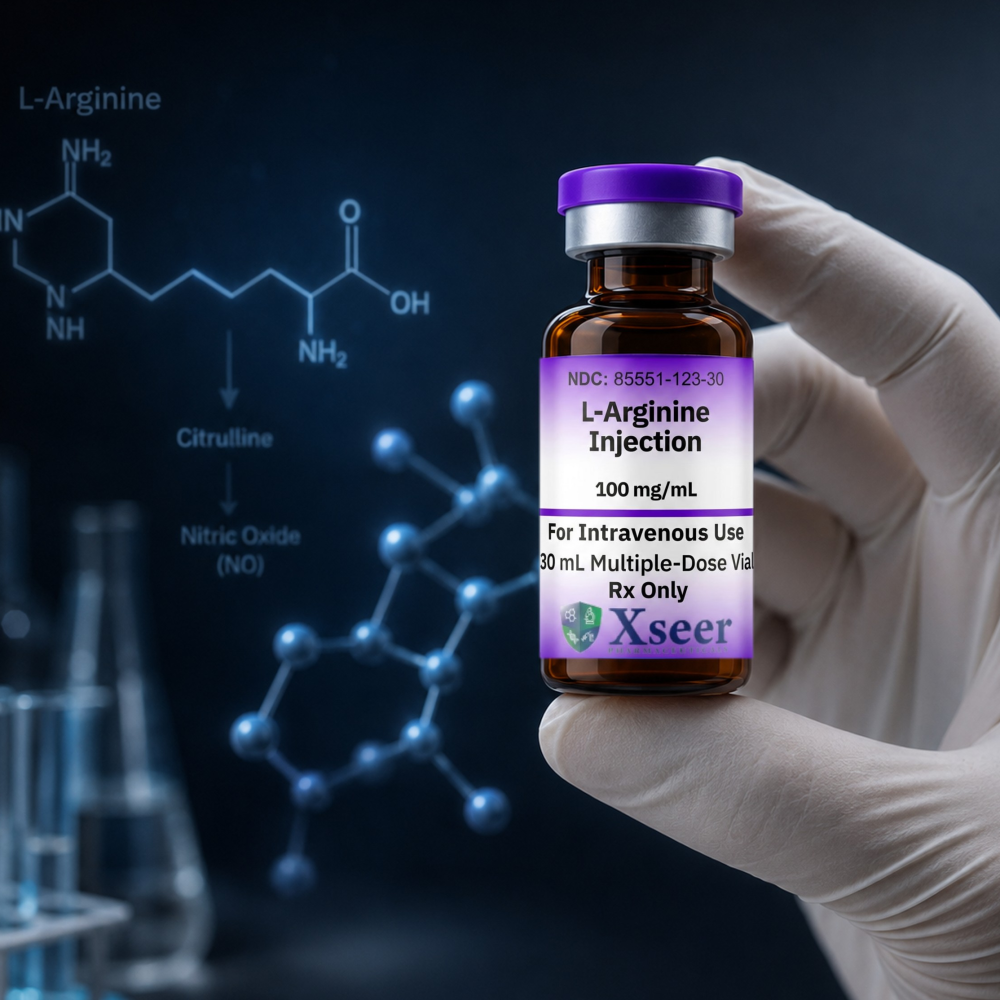
L-arginine is a conditionally essential amino acid and the sole physiological substrate from which mammalian cells generate nitric oxide. Formulated as a hydrochloride salt for parenteral administration, this molecule bypasses the physiological limitations governing its oral counterpart before ever reaching the vascular endothelium.
The regulatory reality dictates careful prescribing: the only FDA-approved injectable arginine product (arginine hydrochloride injection) is approved strictly as a diagnostic aid for assessing pituitary growth hormone reserve. It carries no approved indication for erectile dysfunction, growth hormone augmentation, or athletic performance. Compounded L-arginine HCl injection similarly has no FDA-approved indication for these uses. The following review details the biochemical pathways and published clinical evidence for a healthcare professional audience, without establishing claims of approved efficacy.
The Nitric Oxide Cascade and Substrate-Driven Vasodilation
The production of endothelium-derived relaxing factor relies directly on the oxidation of a guanidino nitrogen of L-arginine by endothelial nitric oxide synthase (eNOS). This oxygen- and NADPH-dependent reaction requires tetrahydrobiopterin (BH4) to yield nitric oxide (NO) and L-citrulline. As a freely diffusible gas, NO moves rapidly from endothelial cells into adjacent vascular smooth muscle, binding to the heme moiety of soluble guanylyl cyclase (sGC) and accelerating the conversion of guanosine triphosphate (GTP) to cyclic guanosine monophosphate (cGMP).
Accumulated intracellular cGMP activates protein kinase G (PKG), driving a reduction in cytosolic calcium levels that relaxes vascular smooth muscle and produces systemic vasodilation. Because L-arginine rests at the origin of this pathway, eNOS activity remains dependent on adequate substrate availability. As explained on the Huberman Lab podcast, arginine acts as a key dietary modulator capable of controlling the dilation of blood vessels and arteries. This baseline vasodilatory effect traces directly back to the eNOS/NO/sGC signaling chain established across peer-reviewed literature.
Synergy with Downstream Effectors
The relationship between upstream substrate availability and downstream enzymatic degradation becomes highly relevant when evaluating phosphodiesterase type 5 (PDE5) inhibitors like sildenafil and tadalafil. These therapeutic agents function downstream of NO by preventing the hydrolysis of cGMP back into inactive GMP. They do not generate a novel vasodilatory signal; they preserve an existing one. If eNOS lacks sufficient L-arginine substrate, the clinical efficacy of PDE5 inhibition is compromised.
On the Huberman Lab podcast, urologist Dr. Rena Malik outlined this biochemical interplay, describing how NO initiates the pathway, cGMP mediates the physical response, and PDE5 inhibitors sustain the signal. She characterized L-arginine as the more direct pathway to NO synthesis while explicitly noting its exceptionally low oral bioavailability—a kinetic limitation explaining why oral monotherapy for erectile dysfunction frequently yields inconsistent clinical trial outcomes.
The Pharmacokinetic Rationale for Parenteral Delivery
Oral administration subjects L-arginine to extensive presystemic metabolism. The intestinal mucosa and hepatic cytosol express high levels of arginase I and II, enzymes that rapidly hydrolyze arginine into ornithine and urea. Combined with substantial first-pass hepatic extraction, this metabolic clearance ensures that oral dosing results in modest, unpredictable shifts in circulating plasma levels.
As noted by Andrew Huberman on the podcast, this extensive gut metabolism restricts oral arginine from accessing target tissues. Historical studies examining growth hormone dynamics relied primarily on intravenous infusions to circumvent this exact issue. L-citrulline serves as a well-documented oral workaround, escaping intestinal arginase and undergoing renal conversion into arginine via argininosuccinate synthase.
Parenteral administration (IV/IM) offers a definitive pharmacokinetic alternative. By entirely bypassing presystemic arginase exposure, the parenteral route delivers the intact compound directly to systemic circulation, ensuring predictable and elevated plasma concentrations. Superior plasma stability is a pharmacokinetic fact, not proof of clinical superiority for unapproved indications.
|
Route |
Presystemic Arginase Exposure | Plasma Arginine Profile |
|---|---|---|
| Oral L-Arginine | High (enterocyte/hepatic arginase, first-pass extraction) | Modest, highly variable; limited by GI intolerance at high doses |
| Oral L-Citrulline | Largely bypassed; undergoes renal conversion to arginine | Higher, more sustained rise in plasma arginine than equivalent oral arginine |
| Parenteral L-Arginine (IV/IM) | Completely bypassed | Significantly higher, highly predictable systemic concentrations |
Somatostatin and Endocrine Dynamics
Growth hormone (GH) secretion from anterior pituitary somatotrophs is regulated by the opposing forces of growth hormone-releasing hormone (GHRH) and somatostatin. A rapid influx of plasma arginine suppresses endogenous hypothalamic somatostatin tone, disinhibiting the somatotrophs and permitting a pronounced pulse of endogenous GH.
This physiological mechanism forms the scientific basis for diagnostic pituitary reserve testing. On the Huberman Lab podcast, Huberman noted that arginine infusions can elevate growth hormone levels by several hundred percent, stressing that this effect is highly sensitive to metabolic context. Elevated blood glucose or insulin spikes can completely blunt the secretagogue effect, making a strictly fasted state a prerequisite for observing this neuroendocrine response.
Clinical data demonstrate that the neuroendocrine response to arginine follows a non-linear pattern. Oral doses exceeding approximately nine grams blunt GH secretion while simultaneously increasing the risk of severe gastrointestinal intolerance. A timing paradox also occurs when arginine is administered prior to physical training. Exercise itself serves as a potent physiological stimulus for GH release. Pre-exercise arginine administration can disrupt the natural exercise-induced GH pulse, clamping the net growth hormone increase.
Given these complex feedback loops, utilizing arginine as a chronic performance or body-composition aid lacks robust clinical support. On the podcast, the literature surrounding pre-sleep arginine supplementation was characterized as weak, with emphasis placed on the fact that true growth-hormone deficiencies require structured, physician-supervised prescription pathways.
Essential Clinical Cautions: HSV-1, Hemodynamics, and Atopy
HSV-1 and Transporter Competition
Herpes Simplex Virus 1 (HSV-1) establishes permanent latency within the sensory neurons of the trigeminal ganglion. Active viral replication is heavily dependent on host arginine pools, whereas L-lysine acts as a direct biochemical antagonist. Both cationic amino acids utilize the same CAT-1 transporter (encoded by SLC7A1) to cross cellular membranes. The intracellular arginine-to-lysine ratio dictates whether latent HSV-1 remains suppressed or undergoes reactivation.
Discussing non-stimulant methods for vascular recruitment, Dr. Andy Galpin noted that while increasing nitric oxide pathways assists nutrient delivery, it carries an explicit risk for HSV-prone individuals. Introducing concentrated arginine or citrulline shifts the systemic amino acid balance, amplifying viral reactivation and triggering cold sore outbreaks.
Pharmaceutical purity does not eliminate this intrinsic biochemical hazard. Providing a highly pure, single-agent arginine load rapidly alters the intracellular environment of infected neurons in favor of viral replication. On a separate episode, Huberman reinforced that activating this pathway inflames trigeminal neurons. Prescribers must evaluate baseline viral histories and provide rigorous counseling, as high-dose regimens are frequently inappropriate for individuals with a history of recurrent herpes labialis.
Hemodynamics and Airway Reactivity
Because systemic vasodilation reduces total peripheral resistance, a rapid parenteral influx of L-arginine can induce transient systemic hypotension accompanied by reflex tachycardia. Elevated peak concentrations achieved via the intravenous route make careful hemodynamic monitoring imperative. Intravenous arginine hydrochloride introduces specific metabolic risks, including hyperkalemia—driven by the displacement of intracellular potassium—metabolic acidosis, and a significant acute chloride load.
Arginine biology behaves differently in chronic inflammatory environments. In atopic and asthmatic patients, inducible nitric oxide synthase (iNOS) is significantly upregulated. Exogenous arginine loading can inadvertently fuel iNOS-driven nitric oxide production, accelerating local nitrosative stress and exacerbating eosinophilic airway inflammation.
|
Population / Clinical Condition |
Underlying Pathophysiological Concern |
|---|---|
| Cardiovascular Disease | Additive hypotension, reflex tachycardia, compromised coronary perfusion |
| Renal Impairment | Severe hyperkalemia risk, impaired drug clearance, metabolic acidosis |
| Hepatic Dysfunction | Disrupted systemic amino acid handling, impaired urea cycle clearance |
| Atopic / Asthmatic Status | iNOS-driven nitrosative stress, heightened eosinophilic airway inflammation |
| Recurrent HSV-1 Infections | Shifted CAT-1 transporter dynamics favoring viral reactivation |
Published literature investigating supplemental arginine protocols generally utilizes a range of 2.8 to 8 grams per day, distinct from the heavy intravenous protocols reserved for diagnostic growth hormone testing. All administration, dosing adjustments, and patient screening must proceed under direct medical supervision.
Navigating 503B Pharmaceutical Quality
Evaluating clinical data requires complete confidence in a compound's identity and dosage accuracy. A 503B outsourcing facility operating under current Good Manufacturing Practice (CGMP) guidelines prepares L-arginine HCl injection as a sterile, single-ingredient formulation. This ensures absolute batch uniformity, defined dose accuracy, and the total exclusion of unlisted fillers, dyes, or hidden active compounds. When a clinician observes a patient response, the result can be confidently attributed to the exact milligram amount of the single active ingredient, allowing for rational clinical adjustments.
This precision contrasts sharply with the commercial supplement marketplace, where multi-ingredient formulations obscure individual responses. Over-the-counter products frequently cluster amino acids, stimulants, and proprietary matrices together, leaving individual components under-dosed or entirely undisclosed. As Dr. Malik emphasized on the podcast, the unregulated supplement market suffers from systemic label inaccuracies, citing independent analyses where active ingredient quantities deviated massively from label claims. Relying on a CGMP-regulated, single-agent compounded preparation eliminates this diagnostic and therapeutic ambiguity.
This content is educational and intended for healthcare professionals. It is not a substitute for clinical judgment or individualized medical advice. Compounded preparations must be prescribed and monitored by a licensed prescriber.