

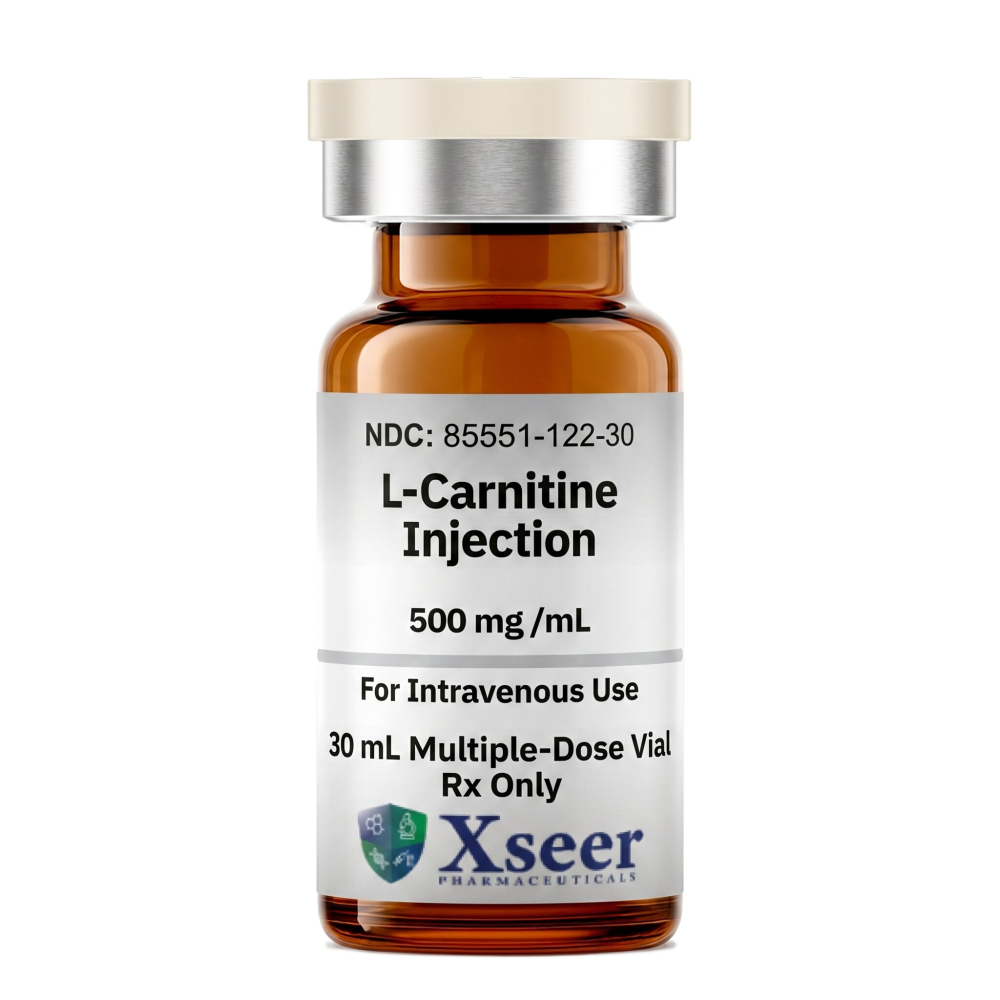
L-Carnitine (Levocarnitine) Injection
500 mg/mL
Size: 30 mLLevocarnitine is a naturally occurring amino acid derivative that supports fatty acid metabolism and cellular energy production. It facilitates the transport of long-chain fatty acids across the inner mitochondrial membrane and contributes to the regulation and removal of selected acyl groups [1–4].
Sterile Levocarnitine Injection is supplied as a 500 mg/mL, preservative-containing solution in a 30 mL multiple-dose vial for intravenous administration by licensed healthcare professionals. The presentation is designed for office or clinical use under appropriate medical supervision [1].
Parenteral administration may be appropriate when oral delivery is unsuitable or when a clinician-directed protocol requires intravenous levocarnitine. Dose, administration rate, frequency, and duration should be individualized according to the patient’s clinical condition, laboratory findings, renal function, and treatment response [1–3].
More About This Product
-
• Concentration: 500 mg/mL
• Volume: 30 mL Multi-Dose Vial
• Route of Administration: Intravenous (IV) Use.
• Dosage form: Sterile, nonpyrogenic, preservative-containing injectable solution
• Administration setting: Office or clinical use; for administration by licensed healthcare professionals
Each mL contains levocarnitine 500 mg, benzyl alcohol 2%, and Sterile Water for Injection. The pH is adjusted to 5.0–6.5 with hydrochloric acid and/or sodium hydroxide [1].
Administer only by the intravenous route. Verify the prescribed dose, administration volume, dilution, and administration rate before use. Rapid administration can increase the likelihood of nausea, vomiting, abdominal discomfort, headache, flushing, dizziness, and local venous irritation [1].
Inspect the solution and container before each administration. Do not use if the solution is cloudy, unexpectedly discolored, contains visible particulate matter, or if the vial or closure is damaged. Use strict aseptic technique during every vial entry, withdrawal, and administration [1].
-
Levocarnitine participates in the carnitine shuttle, which transports long-chain fatty acyl groups across the inner mitochondrial membrane. This transport enables fatty acids to enter the mitochondrial matrix for beta-oxidation and subsequent energy production [2–4].
Levocarnitine also accepts selected acyl groups from acyl-CoA, forming acylcarnitines that can be transported across cellular and mitochondrial membranes. This function contributes to maintenance of the intracellular free coenzyme A-to-acyl-CoA balance and removal of accumulated acyl groups [2–4].
-
Contraindications: Do not administer to patients with known hypersensitivity to levocarnitine, benzyl alcohol, or any component of the formulation. This product is contraindicated in neonates, premature infants, and low-birth-weight infants because of benzyl alcohol toxicity [1].
Hypersensitivity: Monitor for rash, urticaria, dyspnea, hypotension, or anaphylactoid reactions. Discontinue administration immediately and initiate appropriate medical treatment if a serious reaction occurs [1].
Formulation-specific precautions: This formulation contains 2% benzyl alcohol. Use caution in patients with seizure disorders because seizures have been reported during levocarnitine administration. Rapid intravenous administration can increase infusion-related reactions and venous irritation [1].
Clinical monitoring: Consider renal function, fluid status, seizure history, and clinical response when selecting and monitoring treatment. Use caution in patients with compromised renal function because accumulation of metabolites may occur [1,2].
-
Formal interaction studies have not been conducted for this compounded parenteral formulation. Concurrent medications should be reviewed for effects on renal function, fluid balance, seizure threshold, and the patient’s underlying metabolic condition.
Do not combine levocarnitine with another medication in the same syringe, vial, infusion container, or intravenous line unless physical and chemical compatibility has been established for the specific concentrations and administration conditions.
-
Reported or clinically relevant reactions may include:
Hypersensitivity: Rash, pruritus, urticaria, dyspnea, bronchospasm, hypotension, or anaphylactoid reactions
Injection site: Pain, erythema, swelling, venous irritation, or phlebitis
Gastrointestinal: Nausea, vomiting, abdominal discomfort, cramps, or diarrhea
Neurologic: Headache, dizziness, paresthesia, or seizures
General: Flushing, fever, malaise, or characteristic body odor
Cardiovascular: Palpitations, tachycardia, or hypotension, particularly with rapid administration
Serious hypersensitivity, respiratory compromise, a new seizure, or clinically significant worsening of an existing seizure disorder requires prompt evaluation [1,2].
-
Pregnancy: Adequate controlled studies are not available. Administer only when the prescribing healthcare professional determines that treatment is clinically necessary.
Lactation: Levocarnitine is a normal constituent of human milk. Consider maternal clinical need together with the potential for exposure of the breastfed infant [2].
Pediatric use: Carefully calculate and verify the prescribed dose and administration volume. This benzyl-alcohol-containing formulation is not appropriate for neonates, premature infants, or low-birth-weight infants [1].
Older adults and renal impairment: Consider renal function, concurrent conditions, polypharmacy, dialysis status, laboratory findings, and clinical response when selecting and monitoring treatment [1,2].
-
Store at USP Controlled Room Temperature, 20°C to 25°C (68°F to 77°F). Excursions are permitted between 15°C and 30°C (59°F to 86°F) [1].
Protect from light and from deep freezing. Do not freeze.
Inspect the solution and container before each use. Do not use if the solution is cloudy, unexpectedly discolored, or contains visible particulate matter.
Use strict aseptic technique during vial entry and product withdrawal. Follow the product-specific label and applicable facility procedures for handling after initial puncture, beyond-use dating, and disposal.
Keep out of the reach of children.
-
[1] DailyMed. Levocarnitine Injection, 500 mg/mL [Xseer Pharmaceuticals product label]. NDC 85551-122-30. Revised May 2026.
[2] National Institutes of Health, Office of Dietary Supplements. Carnitine: Fact Sheet for Health Professionals. Updated April 17, 2023.
[3] Longo N, Frigeni M, Pasquali M. Carnitine transport and fatty acid oxidation. Biochim Biophys Acta Mol Cell Res. 2016;1863(10):2422–2435. doi:10.1016/j.bbamcr.2016.01.023.
[4] Longo N. Disorders of carnitine transport and the carnitine cycle. Am J Med Genet C Semin Med Genet. 2006;142C(2):77–85. PMID:16602102.
-
This information is intended for licensed healthcare professionals and is provided for product-information purposes only. Refer to the product-specific label, lot-specific Certificate of Analysis, applicable institutional protocols, and independent clinical judgment before ordering, preparing, or administering this compounded drug product.