

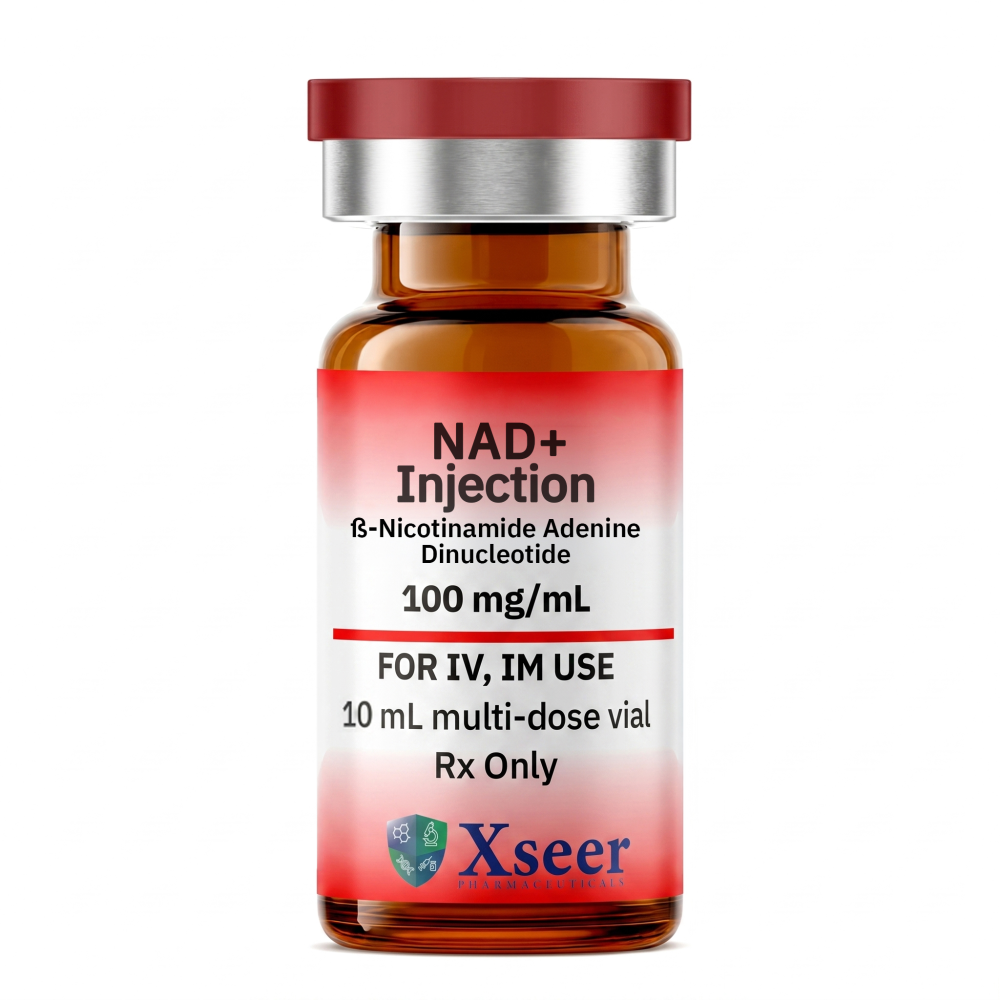
NAD+ Injection
100 mg/mL
Size: 10 mLNicotinamide adenine dinucleotide, commonly abbreviated NAD+, is an endogenous coenzyme involved in oxidation-reduction reactions and cellular energy metabolism. NAD+ also functions as a substrate for enzymes involved in cellular signaling, DNA-damage responses, and metabolic regulation [1–3].
Sterile NAD+ Injection is supplied as a concentrated 100 mg/mL solution in a 10 mL multiple-dose vial for intravenous or intramuscular administration by licensed healthcare professionals. The presentation is designed for office or clinical use under appropriate medical supervision.
Published human evidence concerning direct parenteral NAD+ administration remains limited. Dose, route, administration rate, frequency, and treatment duration should be individualized according to the clinical objective, patient tolerance, and applicable institutional protocol. Endogenous NAD+ biology should not be interpreted as establishing a specific clinical outcome from an injected dose [1–3].
More About This Product
-
• Concentration: 100 mg/mL
• Volume: 10 mL Multi-Dose Vial
• Route of Administration: Intravenous (IV) or Intramuscular (IM) Injection.
• Dosage form: Sterile injectable solution
• Administration setting: Office or clinical use; for administration by licensed healthcare professionals
Verify the prescribed dose, route, and corresponding administration volume before use. For intravenous administration, dilution, compatible infusion solution, administration rate, and infusion duration should follow the product-specific label and validated institutional procedures.
Human studies indicate that intravenous NAD+ tolerance can be rate dependent. Monitor the patient throughout administration and reduce or discontinue the infusion if clinically significant gastrointestinal, cardiovascular, or systemic symptoms occur [2,3]. For intramuscular administration, select an appropriate injection site and avoid direct injection into blood vessels or peripheral nerves.
Inspect the solution and container before each administration. Do not use if the solution contains visible particulate matter, precipitation, cloudiness, unexpected discoloration, or if the vial or closure is damaged. Use strict aseptic technique during every vial entry, withdrawal, and administration.
-
NAD+ and its reduced form, NADH, participate in reversible electron-transfer reactions central to glycolysis, the tricarboxylic acid cycle, mitochondrial oxidative phosphorylation, and other metabolic pathways [1].
NAD+ also acts as a substrate for NAD+-consuming enzymes, including poly(ADP-ribose) polymerases, sirtuins, and cyclic ADP-ribose synthases. These established functions describe endogenous intracellular NAD+ biology; they do not determine tissue delivery, intracellular uptake, or clinical response following parenteral administration [1,2].
-
Contraindications: Do not administer to patients with known hypersensitivity to NAD+ or any component of the formulation.
Hypersensitivity: Observe patients for rash, urticaria, facial or airway swelling, bronchospasm, respiratory difficulty, hypotension, or other evidence of a serious reaction. Discontinue administration immediately and initiate appropriate medical treatment if a serious reaction occurs.
Formulation-specific precautions: Intravenous NAD+ can produce rate-associated intolerance. Published human data have described nausea, abdominal discomfort, increased heart rate, and chest pressure during infusion. Administration rate should be individualized according to patient tolerance [2,3].
Clinical monitoring: Monitor patient tolerance, heart rate, blood pressure, and symptoms throughout intravenous administration. Evidence supporting repeated parenteral use remains limited, and treatment protocols should be individualized [2,3].
-
Formal interaction studies have not been conducted for this compounded parenteral formulation. Concurrent medications should be reviewed for effects on blood pressure, heart rate, glucose metabolism, fluid status, and renal or hepatic function.
Do not combine NAD+ with another medication, vitamin, mineral, amino acid, antioxidant, or compounded preparation in the same syringe, vial, infusion container, or intravenous line unless physical and chemical compatibility has been established.
-
Reported or clinically relevant reactions may include:
Hypersensitivity: Rash, urticaria, facial swelling, bronchospasm, dyspnea, hypotension, or anaphylaxis
Injection site: Pain, tenderness, erythema, swelling, or local irritation
Gastrointestinal: Nausea, vomiting, abdominal discomfort, or cramping
Neurologic: Headache, dizziness, or lightheadedness
General: Flushing, warmth, sweating, fatigue, or anxiety
Cardiovascular: Increased heart rate, palpitations, chest pressure, or blood-pressure changes
Moderate or severe gastrointestinal symptoms, chest pressure, marked tachycardia, hypotension, respiratory compromise, or cardiovascular instability requires immediate adjustment or discontinuation and medical evaluation [2,3].
-
Pregnancy: Adequate controlled studies of parenteral NAD+ administration during pregnancy are not available. Administer only when the prescribing healthcare professional determines that the potential benefit justifies the potential risk.
Lactation: Clinical data concerning parenteral NAD+ administration during lactation are insufficient. Consider maternal clinical need together with potential exposure of the breastfed infant.
Pediatric use: Safety and dosing have not been established specifically for this 100 mg/mL, 10 mL presentation. Pediatric administration requires precise calculation and independent dose verification.
Older adults and organ impairment: Consider cardiovascular status, renal and hepatic function, concurrent medical conditions, polypharmacy, and the limited clinical evidence supporting repeated parenteral administration.
-
Store at USP Controlled Room Temperature, 20°C to 25°C (68°F to 77°F).
Protect from light and keep the vial in its original carton until use. Do not freeze.
Inspect the solution and container before each use. Do not use if the solution contains visible particulate matter, precipitation, cloudiness, or unexpected discoloration.
Use strict aseptic technique during vial entry and product withdrawal. Follow the product-specific label and applicable facility procedures for handling after initial puncture, beyond-use dating, and disposal.
Keep out of the reach of children.
-
[1] Covarrubias AJ, Perrone R, Grozio A, Verdin E. NAD+ metabolism and its roles in cellular processes during ageing. Nat Rev Mol Cell Biol. 2021;22(2):119–141. doi:10.1038/s41580-020-00313-x.
[2] Grant R, Berg J, Mestayer R, et al. A pilot study investigating changes in the human plasma and urine NAD+ metabolome during a 6-hour intravenous infusion of NAD+. Front Aging Neurosci. 2019;11:257. doi:10.3389/fnagi.2019.00257.
[3] Reyna K, Heinzen G, Patel N, et al. Intravenous infusion of nicotinamide adenine dinucleotide (NAD+) versus nicotinamide riboside: a retrospective tolerability pilot study in a real-world setting. Front Aging. 2026;7:1652582. doi:10.3389/fragi.2026.1652582.
-
This information is intended for licensed healthcare professionals and is provided for product-information purposes only. Refer to the product-specific label, lot-specific Certificate of Analysis, applicable institutional protocols, and independent clinical judgment before ordering, preparing, or administering this compounded drug product.